
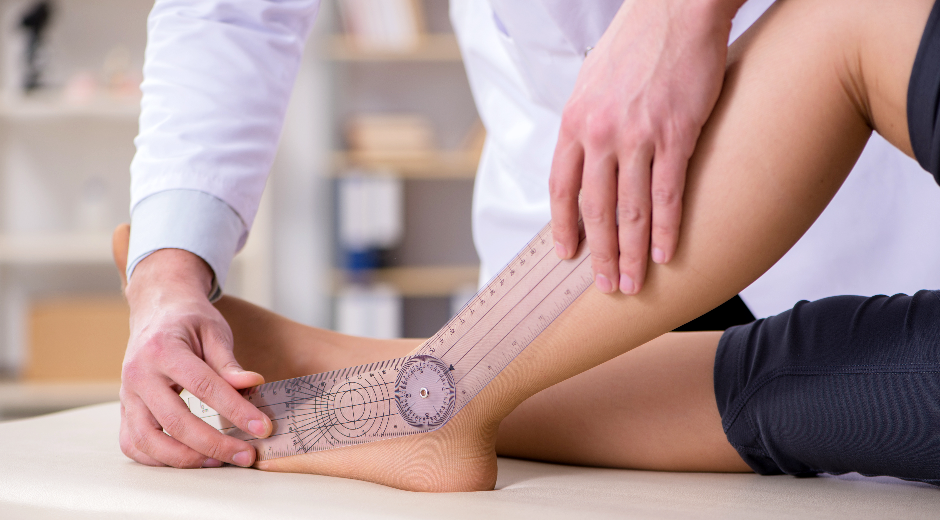
The Orthopaedic physical examination required in a forensic examination by a Qualified Medical Evaluator of an injured worker in California through the Division of Workers’ Compensation relies on the use of specific tools that are mandatory to assess the worker for the purposes of determining presence and causation of injury, improvement, and impairment. A QME must follow the specific instructions in the AMA Guides 5th Edition in order to comply with state law and submit an acceptable report, even though the examination likely differs greatly from the examination used in clinical practice. This includes use of specific tools, whose requirements and usage are specifically described in the AMA Guides 5th Edition.
It is the QME’s duty to determine rating by numerous methods, so range of motion, limb circumference, strength, and pain may all be needed for a single injury to allow for the most appropriate rating.
All Orthopaedic Surgeons must have these items in their toolbox.
Goniometers of various sizes
A great number of ratings in California are predicated on the loss of range of motion. For that reason, the AMA Guides 5th Edition requires precision in the measurement of joint range of motion. These simple yet effective devices come in various forms – from traditional manual goniometers to more advanced digital versions. These familiar instruments to an Orthopaedic Surgeon should be used to measure all range of motion in a joint according to the specific instructions in the AMA Guides 5th Edition. The measurements must be performed three times, with the maximum reported in the QME report.
Bubble Inclinometers
Inclinometers are devices that measure range of motion of the cervical, thoracic, and lumbar spine. Two inclinometers are used—one cranial and one caudal to the segment of the spine to be measured. Subtracting the difference between the ranges of motion demonstrates the range of motion of that isolated segment. While specific instructions and images are included in the AMA Guides 5th Edition, understand that both inclinometers need to be “zeroed” (rotated such that the bubble is at 0 with the fluid level parallel to the floor). The applicant is then asked to flex, extend, or laterally bend that segment of the spine and both numbers are then noted. For instance, if the cranial goniometer reads 35 degrees in forward flexion, but the caudal goniometer (at C7) reads 10 degrees, the forward flexion range of motion is 25 degrees. Please reference the Guides for more specific instructions. The measurements must be taken three times and averaged, with each of the measurements documented in the QME report.
Jamar Dynamometer
Grip strength is a common measurement used for rating due to its ability to approximate hand function. The Jamar Dynamometer is the standard for measurement due to its reliability, ease of use, and consistent results. It’s engineered to measure isometric grip strength, which involves the contraction of muscles without any joint movement. QMEs are to obtain three separate grip strengths on each hand at different times throughout the examination and document in the QME report.
A substitute for the Jamar is pinch strength, but grip strength is more widely used for practicality.
Measuring Tape
A measuring tape is used to measure girth or circumference of the arm, forearm, thigh, and calf, and can be useful for limb length discrepancies as well. These measurements are often used for rating by atrophy. It is also useful for an accurate description of surgical incisions and wounds.
Reflex Hammer
The cervical and lumbar spine examinations require a careful neurologic examination, including reflexes for C5 (biceps), C6 (triceps), C7 (brachioradialis), L4 (patellar tendon), and S1 (Achilles tendon).
Two-Point Discriminators
Two-point discrimination is mandatory for digital lacerations with concern for nerve injury. While many Orthopaedic Surgeons are accustomed to rudimentary tools for this, the accuracy of reporting exact distance of two-point discrimination with the wheels allows for a better assessment of the ulnar and radial digital nerves.
It is helpful to have an active QME demonstrate these instruments if you need a refresher. At OrthoLegal, we have our new QMEs work with existing QMEs to learn the most accurate and efficient physical examination. We always recommend familiarity with the instructions in the Guides, but an in-person demonstration can be incredibly useful for a new QME. Reach out to us if you’re having difficulty and we’ll be happy to see how we can help you.