

An independent medical examination (IME) is an evaluation by a physician who assesses medical questions in a legal or insurance claim without providing treatment. In California workers’ compensation, disputed medical issues are generally evaluated through the Qualified Medical Evaluator (QME) or Agreed Medical Evaluator (AME) process.
OrthoLegal supports orthopaedic IMEs and other medical-legal evaluations across California. Below, we explain how these evaluations differ, who requests them, and what to expect. Our page on personal injury and independent medical examinations describes our IME services.
What is an IME?
An IME is a medical-legal examination by a physician who has no treating relationship with the examinee. The physician reviews records, takes a history, examines the person and then writes a report. That report answers the questions the requesting party or agency poses, such as diagnosis, cause, work capacity and impairment.
The term covers several settings, each with its own rules:
- Personal injury lawsuits, where a defendant may demand a physical exam of a plaintiff who claims injury.
- Federal employees’ workers’ compensation claims under FECA, where the Office of Workers’ Compensation Programs (OWCP) directs second opinion and referee exams.
- Fitness for duty evaluations, where an employer asks whether an employee can perform the job’s duties.
So what is an IME in a given case? It depends on which system the exam belongs to.
Who orders an IME in California, and who pays for it?
The party or agency that needs a medical opinion orders the IME, and each system sets its own payment rules. In a California personal injury lawsuit, the defendant may demand the exam and names the examiner in the demand. For a federal claim, OWCP directs the exam and pays the specialist directly.
Under California Code of Civil Procedure section 2032.220, a defendant may demand one physical exam of a personal injury plaintiff without a court order. That exam must take place within 75 miles of the plaintiff’s residence and include no painful, protracted or intrusive test. Other exams need leave of court (section 2032.310).
On the federal side, OWCP also reimburses the employee’s necessary travel costs and lost wages (20 CFR 10.322). Labor Code section 4064 sets a different rule for California workers’ comp: the employer is liable for each reasonable and necessary medical-legal evaluation.
IME, QME or AME: which applies in California?

In a California workers’ compensation claim, the medical-legal evaluation of a disputed issue comes from a QME or an AME, not an IME. The Division of Workers’ Compensation (DWC) Medical Unit certifies QMEs and issues randomly generated panels. An AME, however, is a physician the worker’s attorney and the defense agree on.
The DWC’s fact sheet on QMEs and AMEs lists disputes these evaluators address. Examples include whether work caused the injury, whether the condition is permanent and stationary, and the permanent disability rating. AMEs apply only when the worker has an attorney. If the parties cannot agree on one, the fact sheet says they must ask for a QME.
Treatment disputes follow their own path: utilization review, then independent medical review (IMR), which is not an IME either.
So in a California work injury dispute, the IME vs QME answer is a QME or an AME. See our Qualified Medical Evaluator services page and our comparison of QME and AME evaluations for both routes.
How do IMEs work in federal workers’ compensation claims?
Federal employees’ work injury claims fall under the Federal Employees’ Compensation Act (FECA), which OWCP administers within the U.S. Department of Labor (DOL). OWCP can direct two kinds of exam: a second opinion exam by a specialist, and a referee exam when medical opinions conflict. DOL training material also calls the referee exam an impartial medical examination.
What is an IME in a federal file, then? In DOL usage, the abbreviation can mean that referee exam.
The OWCP claims examiner decides whether to order a second opinion, and a medical referral group under contract with OWCP selects the physician. Attendance is required, and the employee may bring a qualified physician at their own expense (20 CFR 10.320).
Sometimes the employee’s physician and a second opinion physician or OWCP medical adviser disagree. If both reports carry virtually equal weight and rationale, OWCP appoints a third physician, the referee. Under the federal rules on directed examinations, the referee must be qualified in the appropriate specialty and have no prior connection with the case. According to DOL training material, OWCP makes this choice on a strict rotational basis.
Refusing or obstructing a directed exam suspends compensation until the refusal or obstruction stops (20 CFR 10.323). Our Department of Labor case evaluations page covers OrthoLegal’s federal work.
What happens during an orthopaedic IME?
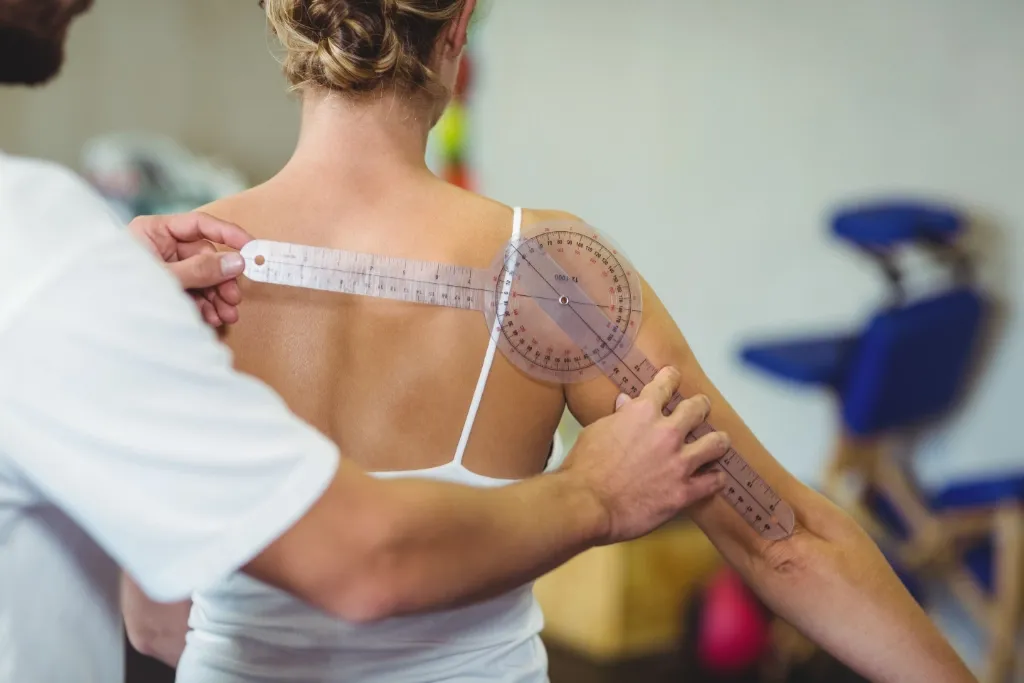
An orthopaedic IME usually has four steps: check-in, a history interview, a records and imaging review, and a physical exam. The physician gathers facts for a report but does not provide treatment. Its focus is the body parts at issue.
- Arrival: check-in, identification and intake forms.
- History: how the injury happened, how symptoms have changed, treatment so far and job duties.
- Records: a check of that account against the records and imaging provided.
- Exam: measurements suited to the body part, such as range of motion, strength, sensation, reflexes, joint stability and gait.
Each step feeds the report. For example, measured findings such as degrees of motion let readers check the opinions against the exam.
What does the IME report contain, and who receives it?
An IME report sets out the history, records reviewed, exam findings and the physician’s reasoned opinion on each question. Who receives it depends on the system. After a California civil exam, the party that arranged it holds the report, and the examinee’s side can demand a copy.
The deadline under Code of Civil Procedure section 2032.610 is 30 days after service of the demand, or within 15 days of trial if earlier.
Federal FECA claims work differently. When one opinion has more probative value, OWCP bases its decision on it (20 CFR 10.321). The Employees’ Compensation Appeals Board gives special weight to a well-rationalized referee opinion based on a proper factual background.
A California QME report, by contrast, goes to both sides at once. Under Title 8, California Code of Regulations, section 41, the QME serves the employee, the claims administrator and their attorneys at the same time. Section 38 generally allows 30 days after the exam for the report.
Frequently asked questions
How long does an IME take?
The length of an IME varies with the case. Visits run longer when the history is complex, several body parts are in question or the records are extensive. Before the visit, the scheduling notice or whoever arranged the exam can give an expected time.
Can I bring someone to an IME in California?
It depends on the system. For a California civil exam, the examinee’s attorney may observe without taking part and record what is said by audio or stenography. So may a representative the attorney authorizes in writing. At a federal second opinion exam, the employee may bring a qualified physician at their own expense. Anyone else needs supporting medical evidence or a finding of exceptional circumstances by OWCP, though an interpreter is allowed as an accommodation.
Is the IME doctor neutral?
An IME physician’s role is to provide an objective medical opinion based on the examination, records and relevant medical evidence. Who selects or pays the physician does not, by itself, establish whether the opinion is impartial.
Selection procedures differ by system. In a California personal injury lawsuit, the defendant may select the examiner. In federal FECA claims, OWCP selects physicians for directed examinations. California QMEs must reach conclusions without bias for or against either side, while AMEs are selected by agreement between the worker’s attorney and the defense.
How OrthoLegal supports orthopaedic evaluations
OrthoLegal coordinates orthopaedic evaluations for California workers’ compensation and personal injury matters, federal DOL claims, and fitness for duty reviews. Our team handles scheduling, records and report support, with a focus on quality, on-time reporting. To request an evaluation, call 213.947.0000 or use the request form.
Request an Evaluation (button, links to /for-applicants-attorneys/)
This article is general information, not legal or medical advice. For advice about a specific claim or examination, talk to your attorney.